Heart Disease in Indians: Earlier, Deadlier, and Often Missed

Why traditional tests fail to predict cardiac risk in India

1. Burden of Heart Disease

Cardiovascular disease (CVD) remains the leading cause of mortality worldwide, accounting for approximately 32% of all global deaths. Coronary heart disease (CHD) constitutes the largest share of this burden.

South Asians are disproportionately affected. Atherosclerotic cardiovascular disease (ASCVD) occurs 5–10 years earlier, with higher mortality at lower BMI and LDL-C levels compared with Western populations.

Key insight: Traditional risk factors alone do not fully explain this excess risk in Indians. Metabolic risk is central.
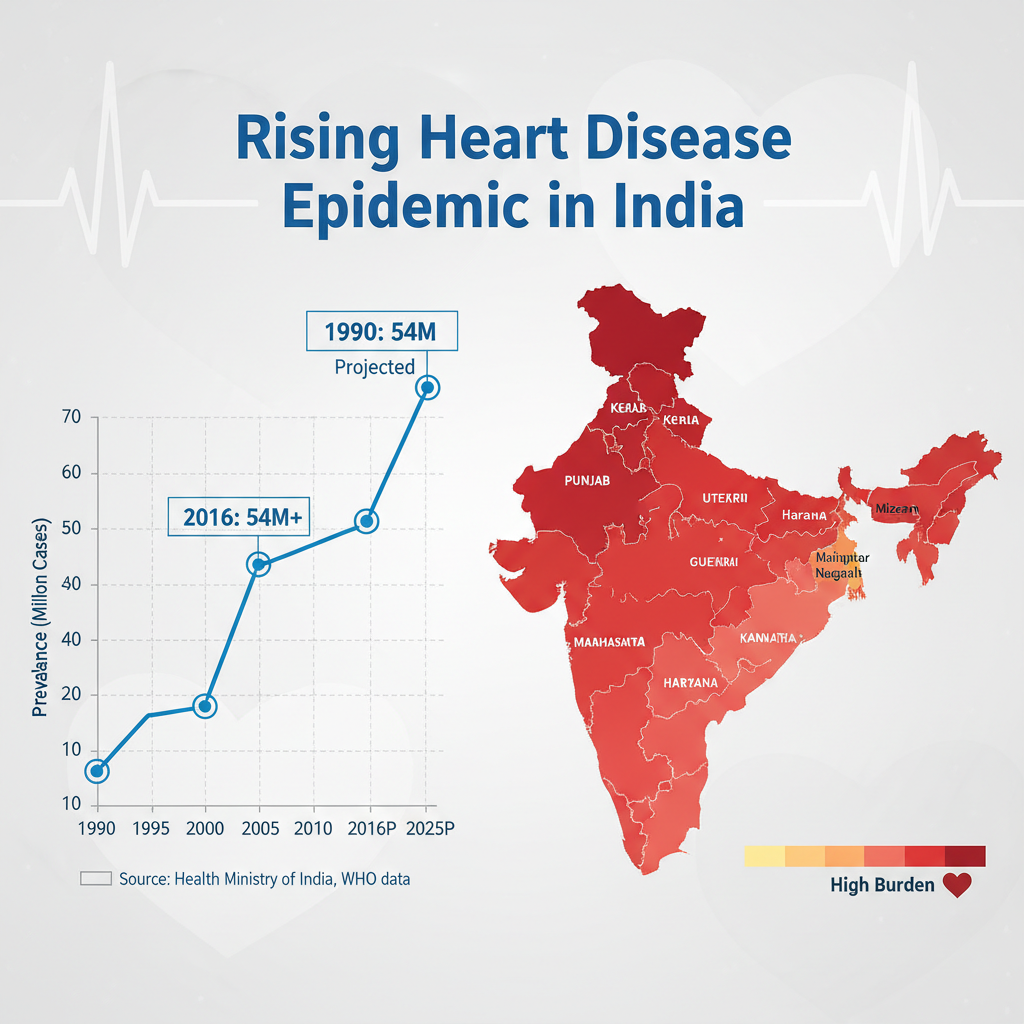
Heart Disease Risk in Indians

2.Established (Classical) Risk Factors

2.1 Non-modifiable Risk Factors

  • Age
  • Male sex
  • Genetics / family history of premature coronary artery disease (CAD)

These factors determine baseline susceptibility but are not directly actionable.

2.2 Modifiable Traditional Risk Factors

Dyslipidaemia & Hypertension

  • Elevated LDL-C is causally linked to atherosclerosis
  • Non-HDL cholesterol and ApoB are superior predictors
  • Many Indians develop CAD despite “normal” LDL-C
  • Each 20 mmHg rise in systolic BP doubles cardiovascular mortality
  • Masked and nocturnal hypertension contribute to residual risk

3. Diabetes and Glycaemia

  • Diabetes confers a 2–4-fold higher coronary risk
  • Prediabetes and post-prandial hyperglycaemia increase ASCVD risk
  • HbA1c demonstrates a continuous risk relationship
  • Risk begins years before diabetes diagnosis

4. Insulin Resistance: The Missing Link

  • Precedes diabetes, hypertension, and dyslipidaemia
  • Drives visceral obesity and fatty liver
  • Promotes endothelial dysfunction and inflammation
  • Creates a prothrombotic state

Insulin Resistance–Based Indices

METS-IR

  • Associated with coronary artery calcification
  • Linked to carotid intima–media thickness
  • Predicts incident ASCVD events
  • Independent of LDL-C and HbA1c

TyG Index

  • Predicts major adverse cardiovascular events
  • Correlates with coronary plaque burden
  • Outperforms fasting glucose alone

Evidence-Aligned Preventive Framework

  • ASCVD risk score for event prediction
  • Insulin resistance markers (METS-IR or TyG)
  • Waist circumference and fat distribution assessment
  • Blood pressure and lifestyle evaluation
  • Lifetime cardiometabolic risk estimation

Heart disease is fundamentally a cardiometabolic disorder, driven by insulin resistance and visceral adiposity, with dyslipidaemia acting as a downstream mediator.


Risk of Heart Disease Risk of Diabetes Risk of Obesity Heart Disease Prevention Diabetes Prevention Obesity Prevention

Call WhatsApp